
On Mar 15, 2025, I had the pleasure of presenting at the Cloud Native Community Japan – eBPF Japan Meetup #3, where I introduced Tetragon’s implementation of eBPF-based Process Lifecycle Monitoring.
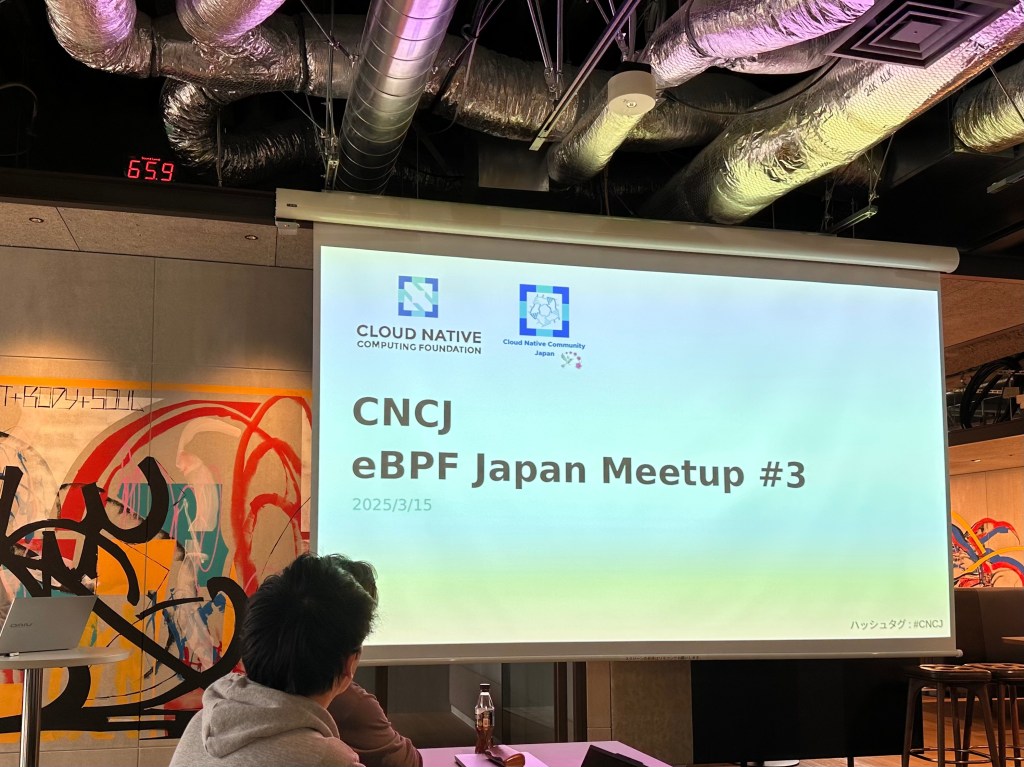
I’d like to share a brief overview of my talk in this blog post.
You can access all my materials here:

About Tetragon
Tetragon is an eBPF-based security observability and runtime enforcement tool that has gained significant traction in the cloud native community. As a CNCF project and subproject of Cilium, Tetragon leverages eBPF’s capabilities to monitor system events at the kernel level with minimal overhead. Version 1.0 was released in November 2023, and the project has continued to evolve with regular updates.
Process Lifecycle Monitoring

My presentation focused on how Tetragon implements process lifecycle monitoring, which is essential for security observability and enforcement. I demonstrated practical applications of process lifecycle data, including:
- Finding processes with elevated privileges (CAP_SYS_ADMIN)
- Detecting suspicious shell executions and understanding process hierarchies
Technical Deep Dive
A significant portion of my talk was dedicated to explaining the internal workings of Tetragon’s monitoring mechanism.

- Linux fundamentals: The key kernel concepts like task_struct, TGID vs PID distinctions, and process management syscall.
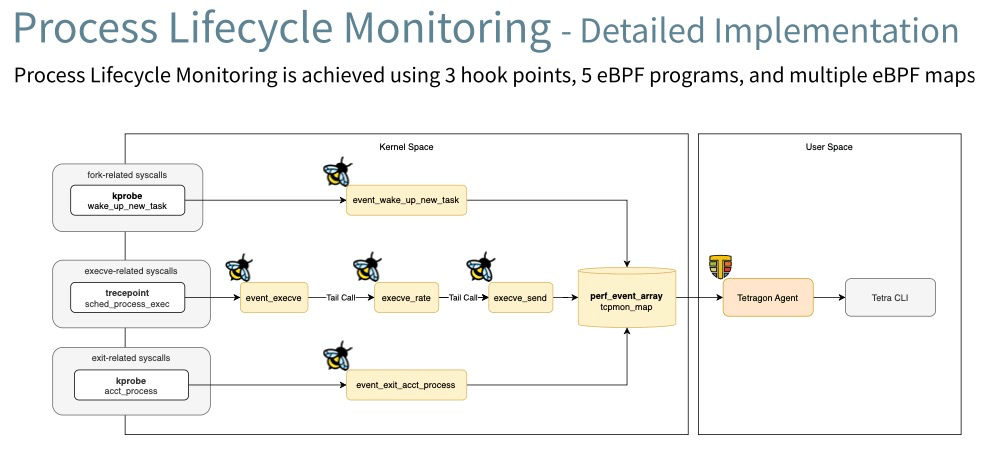
- Fork events: How Tetragon attaches to the
wake_up_new_taskfunction via kprobes to detect process creation - Execve events: The use of tracepoints on
sched/sched_process_execto monitor program execution - Exit events: Leveraging
acct_processkprobes to detect process termination
I also shared some advanced eBPF techniques used in Tetragon, including:
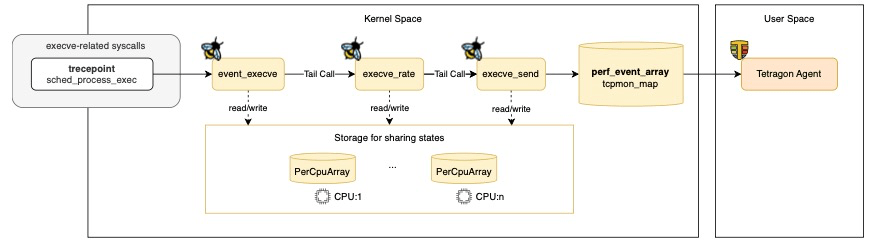
- Tail call chaining for complex event processing
- Data sharing between eBPF programs using Per-CPU maps
Looking Forward
Working with eBPF and Tetragon has been a fascinating journey🐝.
The meetup provided a great opportunity to connect with other eBPF enthusiasts and share knowledge about this powerful technology. I’m excited to continue exploring eBPF’s capabilities and contributing to projects like Tetragon that make complex security observability more accessible.
If you’re interested in the slides or want to discuss eBPF further, feel free to reach out!

 Yuki Nakamura's Blog